Aquarium Plants for Beginners: How to Choose, Plant and Care for Them
Stuart Larmour2026-10-15T13:14:35+00:00Java Plants Knowledge Centre · Beginner’s guide
Your first planted aquarium starts here
A few well-chosen plants can transform an aquarium. Think leafy wood, soft patches of moss and taller stems creating a green backdrop for your fish.
You do not need to start with a complicated aquascape. Choose plants that suit your equipment, learn how to plant them correctly and build a manageable care routine. This guide will help you take those first steps.
1. Choose plants for the aquarium you have
Before choosing plants by appearance, check your aquarium’s lighting, temperature, size and substrate—the material covering the bottom of the tank. Also consider whether you plan to use an injected CO₂ system.
For a straightforward first setup, look at plants labelled Easy in Tropica’s range. Check each plant’s individual requirements and eventual size before buying. A small plant in a pot may grow much larger once established.
Start with a look you can maintain. A planted piece of wood, a group of leafy plants and some taller background growth can make a beautiful aquarium without needing a dense carpet or demanding red plants.
Give each plant a place
- At the back: use taller plants to build depth, allowing space for their mature growth.
- Through the middle: group leafy plants around your main wood or rock feature.
- At the front: keep the view open with lower-growing plants or a clear area of substrate.
Our suggested approach is to repeat a few suitable varieties in small groups. This makes planning easier and creates a more coordinated appearance.
2. Four plants worth exploring
These familiar aquarium plants offer different leaf shapes and ways to build your layout. Select the variety that suits your tank; requirements and mature sizes can vary.
Anubias barteri var. nana
Anubias brings broad leaves and a strong visual shape to an aquarium. Many varieties work well attached to wood or rock.
Planting reminder: keep the rhizome—the thick stem connecting the roots and leaves—above the substrate.
Java fern — Microsorum pteropus
Java fern, commonly sold as Microsorum pteropus, creates a leafy feature on wood or rock. Different varieties offer different leaf shapes.
Planting reminder: like Anubias, its rhizome must not be buried.
Cryptocoryne wendtii Green
A useful option for leafy groups in the substrate. Its appearance and space requirements depend on the variety and growing conditions.
Layout idea: use a group beside your main wood or rock feature to soften the edge.
Bacopa caroliniana
Bacopa adds upright stems and rounded leaves, giving a different texture beside ferns and Cryptocoryne. Tropica describes it as suitable for aquarists of different experience levels.
Care reminder: allow room for growth and trim established stems as needed.
Explore our potted aquarium plants or browse plants already attached to wood for an easy way to introduce a planted feature.
3. Plant correctly from the start
Different plant types need different treatment. Check the label before placing everything into the gravel.
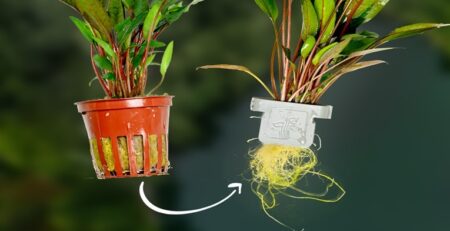
- Prepare potted plants. For the rooted and rhizome plants discussed here, carefully remove the nursery pot and gently tease away the growing wool without unnecessarily damaging the roots.
- Separate stem plants. Plant individual stems with space between them, rather than burying the whole bunch as one tight clump.
- Position rooted plants. Set the roots into the substrate, keeping the crown, where the leaves emerge, at the surface.
- Attach rhizome plants. Secure Anubias and Java fern to suitable wood or rock. Keep the thick rhizome exposed.
- Keep plants damp while working. In a new, unstocked aquarium, planting with a shallow water level can make positioning easier. Refill gently to avoid disturbing your work.
Buying tissue culture plants? Follow the cup’s preparation instructions, including removing the growing medium before planting. Tissue culture describes how the plant is supplied; it does not mean every species has the same care needs.
4. Give your plants a steady start
Use a lighting timer
Tropica recommends starting a newly planted aquarium with around six hours of light per day during the first two to three weeks. Review growth and algae before increasing the lighting period. Leaving the light on all day is not a shortcut to healthier plants.
Plan water changes
New planted aquariums need regular attention. Tropica’s general startup guidance includes changing 25–50% of the water a couple of times a week during the first three to four weeks. Follow any additional instructions for your substrate and use water tests to guide care.
Match feeding to the setup
Fertiliser requirements depend on your plants, substrate and aquarium conditions. Follow the product instructions and avoid adding extra fertiliser simply because a new plant has not grown immediately.
Watch, trim and be patient
Check the filter and timer, remove deteriorating leaves and take a weekly photo. Comparing photographs makes gradual growth easier to see and helps you resist changing several things at once.
Plants do not replace aquarium cycling. Before adding fish or other livestock, establish suitable filtration and confirm that water quality is appropriate. A tank looking green and healthy does not, by itself, mean it is ready for animals.
5. Avoid these common planting mistakes
- Choosing only by colour. Check the plant’s lighting and CO₂ requirements before deciding whether it suits your setup.
- Burying every plant. Rhizome plants need different placement from plants that root in the substrate.
- Ignoring mature size. Leave room for growth and access for maintenance.
- Expecting an instant finished aquascape. Plan for your plants to grow into the layout. Empty space on planting day can be useful.
Your first planted aquarium: common questions
Do I need injected CO₂ to grow aquarium plants?
Not always. Suitable easy-care plants can grow without injected CO₂, provided their other needs are met. Tropica includes beginner layouts using plants suited to this approach. Check each species before buying.
Can I add plants to an existing aquarium?
Yes. Choose plants compatible with the tank’s conditions and inhabitants. Prepare them before planting and work carefully to minimise disturbance. Plants attached to wood or rock can be useful where you want to avoid digging into the substrate.
Should I choose potted or tissue culture plants?
Both can be suitable. Base your choice on the species, your aquarium and the preparation involved. Potted plants need their nursery material removed as appropriate; tissue culture plants need preparation according to the cup’s instructions.
How many plants should I buy?
There is no single number for every aquarium. Tank dimensions, plant size and the layout all matter. Sketch your planting areas first, then choose plants for each area. If you need help, send Java Plants your tank dimensions and details of your lighting.
Ready to plan your planting?
Explore our plant collections or choose individual plants to build your own layout. For help choosing, email sales@java-plants.com with your aquarium dimensions, lighting details and whether you use CO₂.