
How to Grow an Aquarium Plant Carpet: A Step-by-Step Guide
Stuart Larmour2026-11-14T12:30:06+00:00Java Plants Knowledge Centre · Planting guide
Start with a patch. Give it room to spread.
A carpet of live plants can soften the base of a rock or bring a bare foreground to life. Start with one open patch where you can see how the plant grows and reach it easily with tweezers and scissors.
The trick is to choose a plant that suits your tank, split it into small portions and leave space for new growth to fill the gaps.
Choose the look you want
A leafy patch: Hydrocotyle tripartita
Its bright, clover-like leaves look good spilling around the base of a stone. In good light, it can form a low carpet of around 5–10 cm. Trim the upper shoots to keep the patch from turning into a taller mound.
View potted Hydrocotyle tripartitaA fine lawn: dwarf hairgrass
Choose a compact variety such as Eleocharis pusilla ‘Mini’ for a finer, grass-like effect. Plant it in small tufts and give it an open spot with good light so the new growth can fill the gaps.
Browse aquarium carpeting plantsHow to plant an aquarium carpet
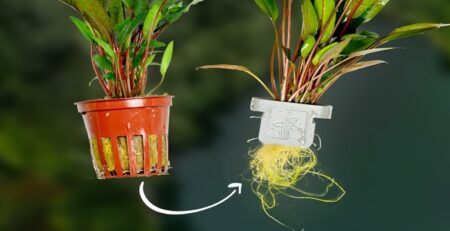
- Prepare the plant. For potted Hydrocotyle, slip off the nursery pot and gently tease away the growing wool. For a tissue culture cup, rinse off the growing medium according to the supplier’s instructions.
- Divide it into small portions. Gently separate the stems or tufts. Several small portions give you more control over the shape of the finished patch than one large clump.
- Plant each portion with tweezers. Ease the roots into the substrate with the leaves above the surface. If you’re setting up an empty tank, shallow water makes it easier to see what you’re doing. Keep the plants damp as you work.
- Leave gaps. Space the portions across the area you want to cover. Stagger them slightly for a less uniform outline.
- Fill or top up gently. If you’re adding water, pour it onto a shallow saucer so the flow doesn’t disturb the substrate. Replant any loose portions before they drift away.
Keep the carpet low as it grows
Watch for new shoots spreading into the gaps. With Hydrocotyle, trim shoots that rise above the rest or creep into an area you want to leave open. Remove loose clippings afterwards so they don’t collect around other plants or the filter intake.
Take a photo on planting day and compare it with a later one. Look for shoots spreading between the original portions. If the plant is growing taller but leaving bare gaps, check what is shading the patch before you make changes to the whole tank.
Common problems and what to try
Why do my plants keep floating up?
Try smaller portions. Ease the roots a little further into the substrate, keeping the leaves exposed. If the patch is directly in the filter’s current, choose a more sheltered spot.
Why is my Hydrocotyle growing tall instead of spreading?
Check for shade from taller plants, large pieces of wood or floating plants. Hydrocotyle makes its most compact growth in good light. Trim taller shoots once the plant is established and keep an eye on the shape of the new growth.
How long will it take to fill in?
There is no fixed timetable. The plant, lighting and starting coverage all make a difference. Look for fresh growth reaching into the gaps before expanding the carpet.
Find a plant for your foreground
Start with a leafy patch beside a rock or try a fine green lawn across an open area.
Shop aquarium carpeting plantsNew to planting? Read our step-by-step aquarium planting guide or explore more advice in the Java Plants Knowledge Centre.
Planting and care references: Tropica’s aquarium planting guide, Hydrocotyle tripartita profile and dwarf hairgrass profile.